


Qu’appelle-t-on pelouses métallicoles et interactions entre plantes ?
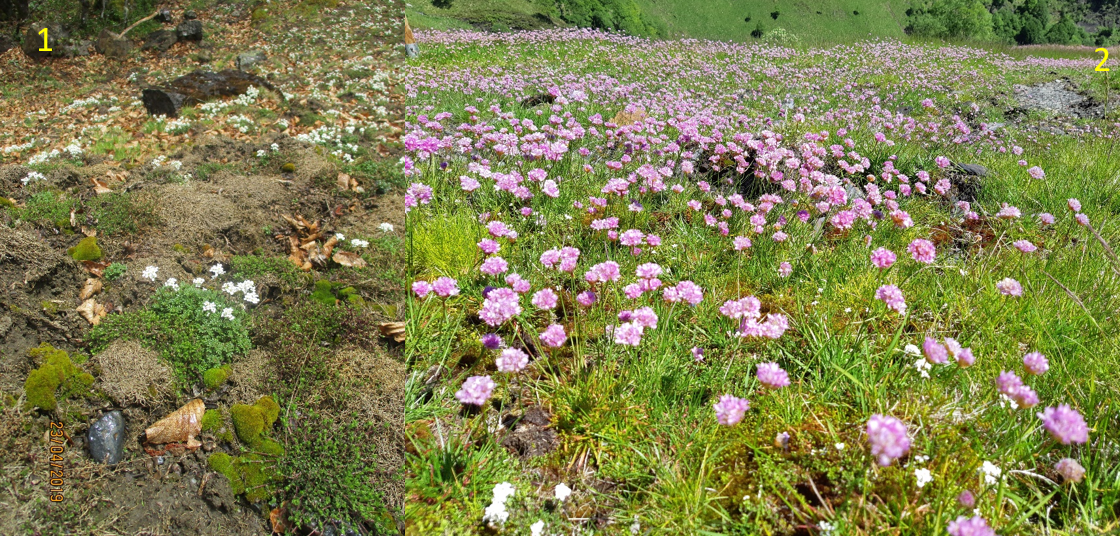
1. Pelouse métallicole dominée par Hutchinsia alpina (fleurs blanches) et Arenaria multicaulis (© F. Delerue)
2. Pelouse métallicole dominée par Armeria muelleri (© V. Mauro)
Les pelouses métallicoles sont des communautés de plantes se développant sur des sols riches en éléments métalliques ou métalloïdes (cuivre, plomb, arsenic, zinc, cadmium etc.). Ces sols sont soit naturels, issus de l’altération de roches cristallines particulièrement riches en ces éléments ou résultant de l’exploitation d’anciens sites miniers. Les plantes se développant sur ces sols sont généralement des plantes adaptées à tolérer le stress. Les pelouses métallicoles sont des formations végétales exeptionnelles car elles sont le résultat de l’évolution et de l’adaptation à des environnements stressés spécifiques après des centaines ou milliers de générations. Elles sont aussi des formations rares présentes dans un nombre limité de sites. Elles représentent un patrimoine biologique unique qui pourrait être utile pour le développement de technique de phyto-remédiation.
Lorsque des plantes poussent à proximité l’une de l’autre, elles peuvent avoir un effet l’une sur l’autre (négatif ou positif) : elles sont en interaction. Dans les pelouses métallicoles, on s’attend à ce que les plantes aient des interactions positives (facilitation) comme dans d’autres milieux stressés (secs ou froids par exemple). La facilitation sous-tend que certaines plantes métallicoles, par leur développement et présence, permettent de diminuer le stress pour d’autres plantes compagnes qui peuvent alors mieux se développer.
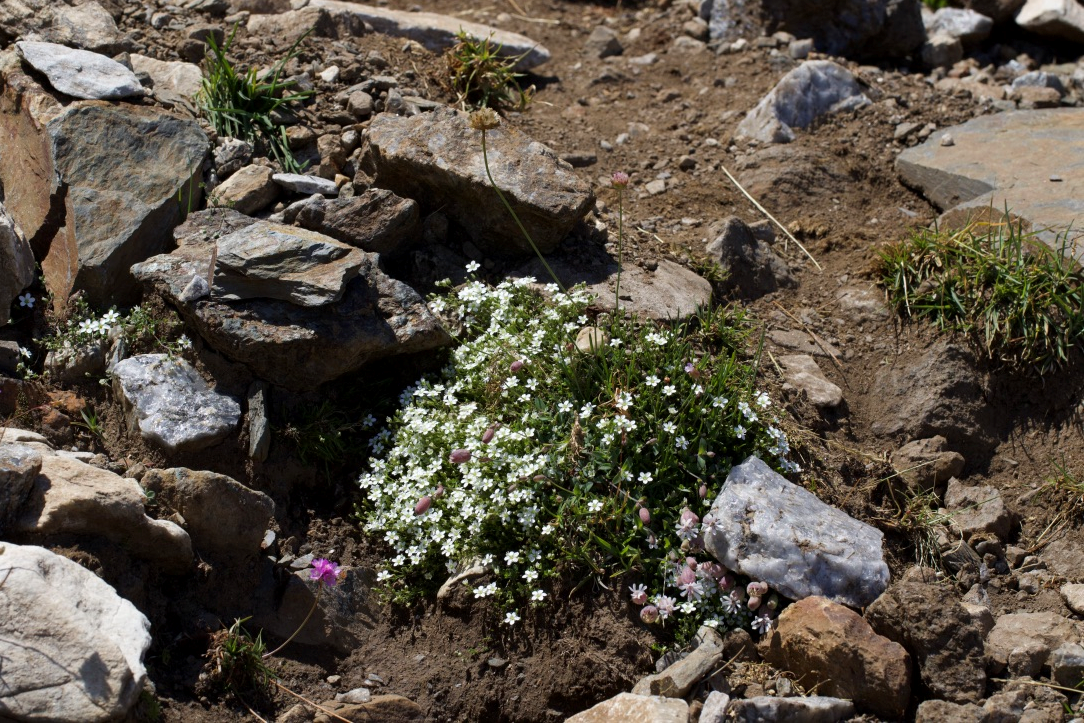
Agrégation d’espèces métallicoles suggérant des interactions positives (© V. Mauro)
Objectifs de cet axe de recherche :
Les objectifs principaux de cet axe de recherche sont de mieux comprendre le long des gradients de présence de métaux dans les sols (de faible présence à présence très marquée) (i) les stratégies fonctionnelles des espèces présentes : comment ces espèces se développent (croissance, survie, reproduction) dans les milieux étudiés, (ii) l’importance et la direction des interactions entre plantes et leur modification le long des gradients de présence de métaux dans les sols, (iii) déterminer les espèces qui sont associées, via la facilitation (iii) les processus impliqués dans les mécanismes de facilitation. A terme, ces recherches devraient permettre de proposer des outils de gestion écologique de ces milieux.
Les approches méthodologiques pour cet axe de recherche combinent : (i) des mesures des traits fonctionnels des plantes permettant de caractériser leurs stratégies fonctionnelles, (ii) des observations sur les associations spatiales des espèces présentes et (iii) des expérimentations in situ pour mesurer les effets des interactions entre plantes. Ces démarches sont effectuées au niveau de différents sites de la vallée du Biros, soit à l’étage montagnard au niveau du Bocard d’Eylie ou de l’ancienne laverie d’Uretz (site de la Plagne) ou dans la zone de Chichoué à l’étage subalpin.
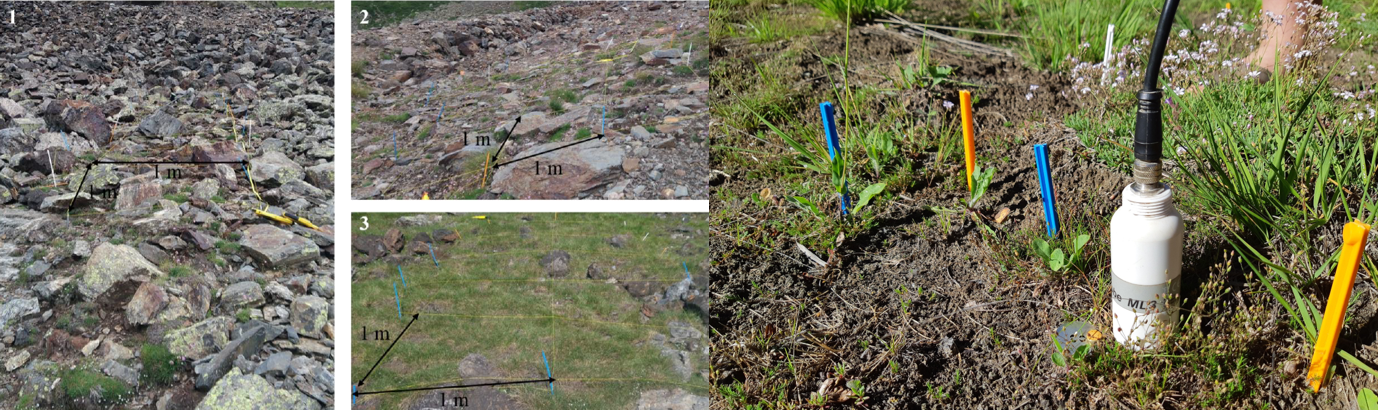
A gauche: étude de la distribution spatiale dans espèces (© N. Naulin)
A droite: suivi des interactions entre plantes et de l’humidité du sol (© H. Rande)
Personnes les plus impliquées :
Florian Delerue, laboratoire GE, Maître de Conférences à l’Institut National Polytechnique de Bordeaux (fdelerue_at_ensegid.fr)
Richard Michalet, laboratoire EPOC, Professeur à l’Université de Bordeaux.
David Nemer, laboratoire EPOC, Doctorant, étudiant l’influence de la provenance des espèces sur leurs réponses aux interactions entre plantes
Hugo Randé, laboratoire EPOC, Doctorant, étudiant les mécanismes déterminant la facilitation des espèces.
Principaux résultats:
Voir les articles publiés (données et publications) concernant les stratégies fonctionelles des espèces présentes dans les systèmes métallifères et sur les interactions entre plantes dans ces milieux
Une brève synthèse est indiquée ici:
D’abord, les syndromes fonctionnels des espèces métallophytes se sont révélés plus diversifiés que prévus en ce qui concerne la conservation ou l’acquisition rapide des ressources du sol (axe fonctionnel du Leaf Economic Spectrum). Deux résultats majeurs sont : 1. Les syndromes fonctionnels montrés, ainsi que les mesures environnementales (WP1), convergent pour montrer qu’en plus de la toxicité métallique, la perturbation (via une instabilité des sols) est un facteur écologique primordial dans le fonctionnement des écosystèmes sur résidus miniers. 2. Une association nouvelle a été montrée entre le Leaf Economic Spectrum et l’exclusion ou l’accumulation des métaux des parties aériennes. L’étude de cette association a conduit à poursuivre l’échantillonnage dans d’autres sites pour vérifier le caractère général de cette association.
Concernant la variation des interactions, les résultats issus des approches observationnelles et expérimentales montrent un passage progressif de la compétition à la facilitation quand la pollution augmente. Ceci confirme la SGH et infirme les modèles alternatifs dans les systèmes étudiés. On précisera que : 1. Les espèces métallophytes sont bien exclues par compétition des zones peu contaminées. 2. La facilitation est d’autant plus importante que les espèces/individus en interactions sont fonctionnellement différenciés, la facilitation contribuant au maintien de la diversité fonctionnelle. Les espèces métallophytes étant elles-mêmes fonctionnellement diversifiées, elles peuvent aussi interagir de manière facilitante, expliquant surement pourquoi la facilitation reste forte même dans les conditions les plus extrêmes.
Concernant les processus liés à la facilitation, il s’agit surtout d’améliorations microclimatiques liés à l’ombrage et à la transpiration des espèces métallophytes. D’autres analyses en cours regarderont plus précisément de possibles effets liés à la stabilisation des sols. Aussi, des effets négatifs d’allélopathie élémentaire ont été démontrés dans les parties peu contaminées des gradients. En effet, c’est là que des espèces accumulant des métaux dans leurs feuilles (et donc dans leur litière) interagissent avec des espèces sensibles peu tolérantes aux métaux.
Aussi, nous avons montré le lien entre ces effets et les syndromes fonctionnels des plantes métallophytes. Les plantes dites acquisitives, qui sont aussi accumulatrices de métaux, sont celles qui ont les effets les plus marqués car : 1. elles transpirent davantage (améliorations microclimatiques) et 2. Elles produisent une litière à partir de leurs feuilles riches en métaux qui se décompose plus rapidement (allélopathie élémentaire).
Ces résultats sont résumés sur l’illustration ci-dessous. Cependant, ces effets ont disparu pendant la canicule de l’été 2022. Considérant le rôle important de la facilitation dans les zones contaminées, cela pose la question de la dynamique de ces communautés dans le contexte du changement climatique.
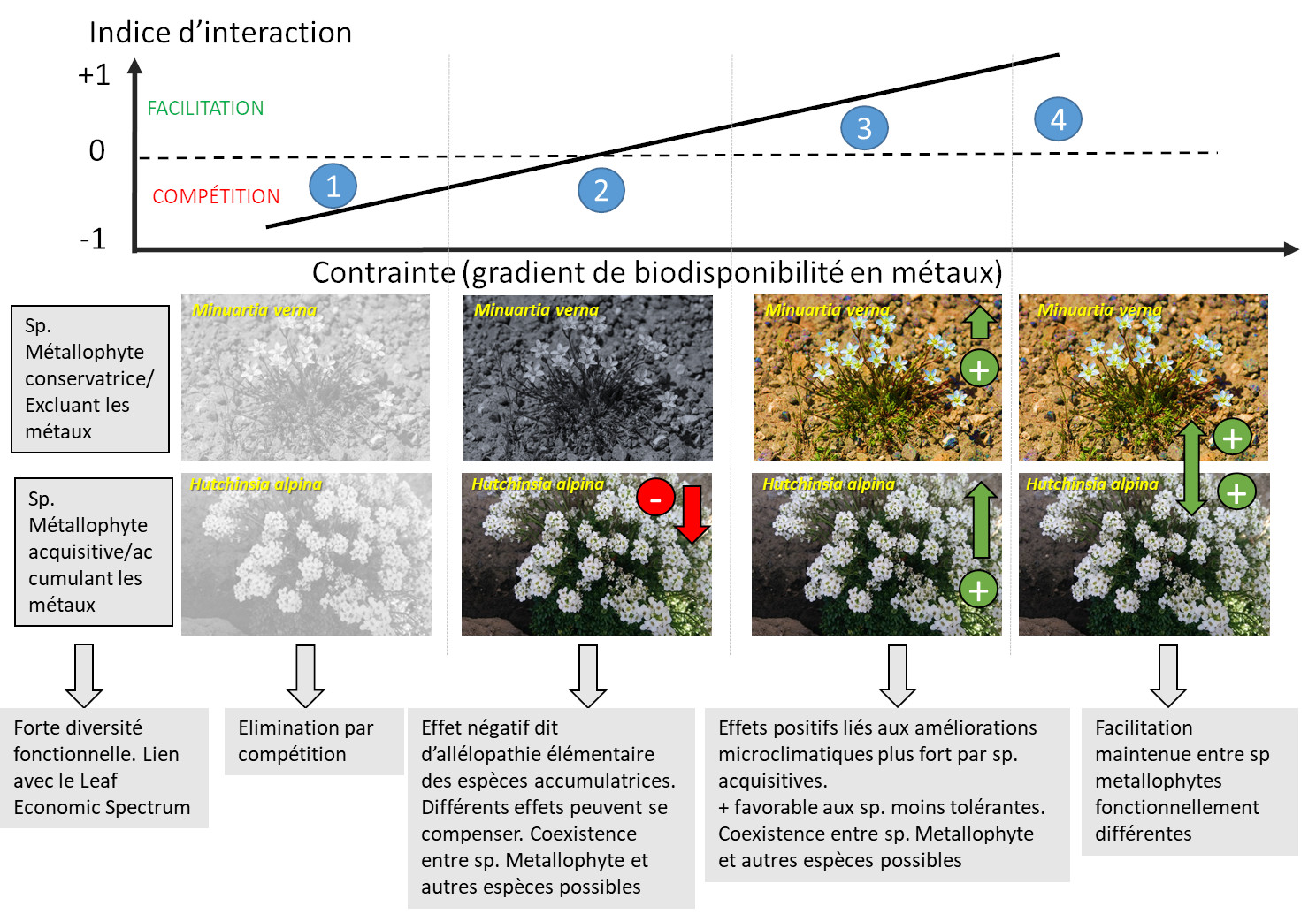
Variation des interactions entre plantes selon les stratégies fonctionnelles des plantes métallophytes le long des gradients de pollution étudiés
